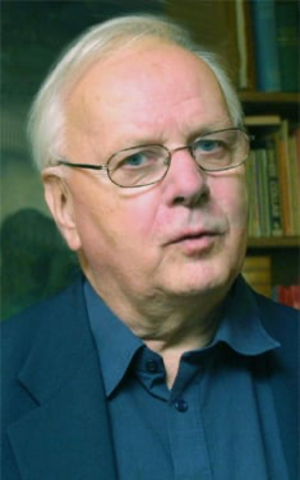
The (tentative) program for the celebration of Kristens Nygaard's 100 year's day will be as follows:
Time: August 27, 2026,
Place: Peter Bøgh Andersen auditorium, Helsingforsgade 12, 8200 Aarhus N
When Kristen gave his first talk at Computer Science in the early seventies, he was basically unknown in Denmark. Today we celebrate him in a building named after him.
His work on Simula was his admission ticket to the department, then part of the Math Institute. His work on languages for programming and system description continued to play a major role throughout our collaboration with him. When he arrived at the department he was working on a new language for system description called DELTA together with Erik Holbæk-Hanssen and Peter Håndlykken. At the department he started The Joint Language Project which led to the development of the Beta language.
His work with the Norwegian Iron and Metal Workers' Union, made him a key figure in developing a whole new type of workplace projects where focus shifted from worker-management cooperation or “your health is at risk” to “IT is transforming work - and not for the better". The message was now that workers and their unions could fight back against IT. In Denmark, this led to the first major project focused on IT where unions and universities cooperated based on the interest of the workers. It later led to the Danish-Swedish Utopia project.
Finally, he had a substantial influence on our teaching through his introduction of “company cases.” Through these cases, the students learned to analyze, describe and develop proposals for improved uses of IT – and sometimes IT systems – in real-life settings.
Kristen’s work in the NJMF project showed us that partnering with major societal players facilitate creation of major changes. Focus was on cooperating with workers and their unions to understand and deal with the changes brought about by management dominated development and use of IT. Later, in the Utopia project, focus was also on developing new IT aimed at improving quality of both work and products.
As time passed by, dealing with IT became “business as usual” for the unions, and at the universities participatory design became “systems development research and teaching as usual” with no strong ties to important societal trends or partners.
Looking at current development practices, Ole and I noticed a surprising lack of good user involvement, and we believe that this in part is responsible for the declining public trust in Danish digitalization. To address this, we began a national initiative together with Dansk IT, DIT, the Danish Academy of Technical Sciences, ATV, and Digital Research Center Denmark, DIREC, to promote “good user involvement,” and this initiative seems to gain momentum.
Today I suggest that fighting for digital independence from potential non-friendly forces should be a new focus for “Nygaard’s children” – and for good citizen involvement.” Reaching out to grass roots organizations and citizens in Europe to find partners in this fight is one of the important next steps – as is creating possibilities, including project funding for the research community and students to participate.
In this talk I will look at Kristen Nygaard’s role in establishing the research area Participatory Design. Kristen was important for the early Iron & Metal Union project together with researchers at the Norwegian Computing Center. I will talk about the Florence project at the University of Oslo where Kristen played an important role. Kristen’s interest in programming languages also influenced the establishment of the Nordic SYDPOL programme (SYstem Development environment and Profession Oriented Languages) and experiments with user-oriented system description languages (the Delta language).
Kristen Nygaard was a politically and socially engaged person who combined a deep interest in computers and programming languages with a social engagement and concern for negative effects of computing. I will talk about Kristen as a creative, social, generous, responsible and touchy colleague and mentor.
In this talk we will describe the development of the Beta language, a long-term collaboration with Kristen Nygaard.
Following the tradition of SIMULA, Beta was designed as a language for programming as well as modeling. This included the development of a conceptual framework for object-oriented programming and modeling.
A unique characteristic of Beta is the unification of abstraction mechanisms like classes, methods, functions, types, and process types into a single abstraction mechanism called pattern. In addition, Beta supports patterns as first-class values. Beta also introduce the notion of singular objects, which are objects that are not instances of classes.
Beta has generalized the notion of cooperative coroutines from SIMULA and the notion of preemptive coroutines as introduced by the Lund SIMULA System, as well as the support for writing schedulers for coroutines and parallel processes (active objects).
The main benefit of object-oriented programming is often said to be strong support for reuse of code. In the talk we will emphasize that that the main benefit of object-orientation is modeling and not reuse of code – reuse of code is an additional benefit.
One of the most interesting oddities in how programming historically developed within computing has been the emphasis on "algorithms" (procedures and data structures, etc.) rather than "systems design", despite outstanding early examples of "systems oriented" building ideas and working tools such as Simula and Sketchpad. This talk will be about how encounters with both within the same week sparked ideas that were more systems oriented.
C++ was born out of a wish to merge facilities for high-level organization of code (represented by Simula) with the ability to use low-level facilities to efficiently and directly exploit hardware (represented by C). Over the years, C++ evolved significantly to better approximate this ideal. Here I focus on the facilities that evolved out of Simula classes and why. This mainly relates to generic programming and resource management.
I will also say a few words about meeting Kristen Nygaard, and how it helped shape my ideals for software.