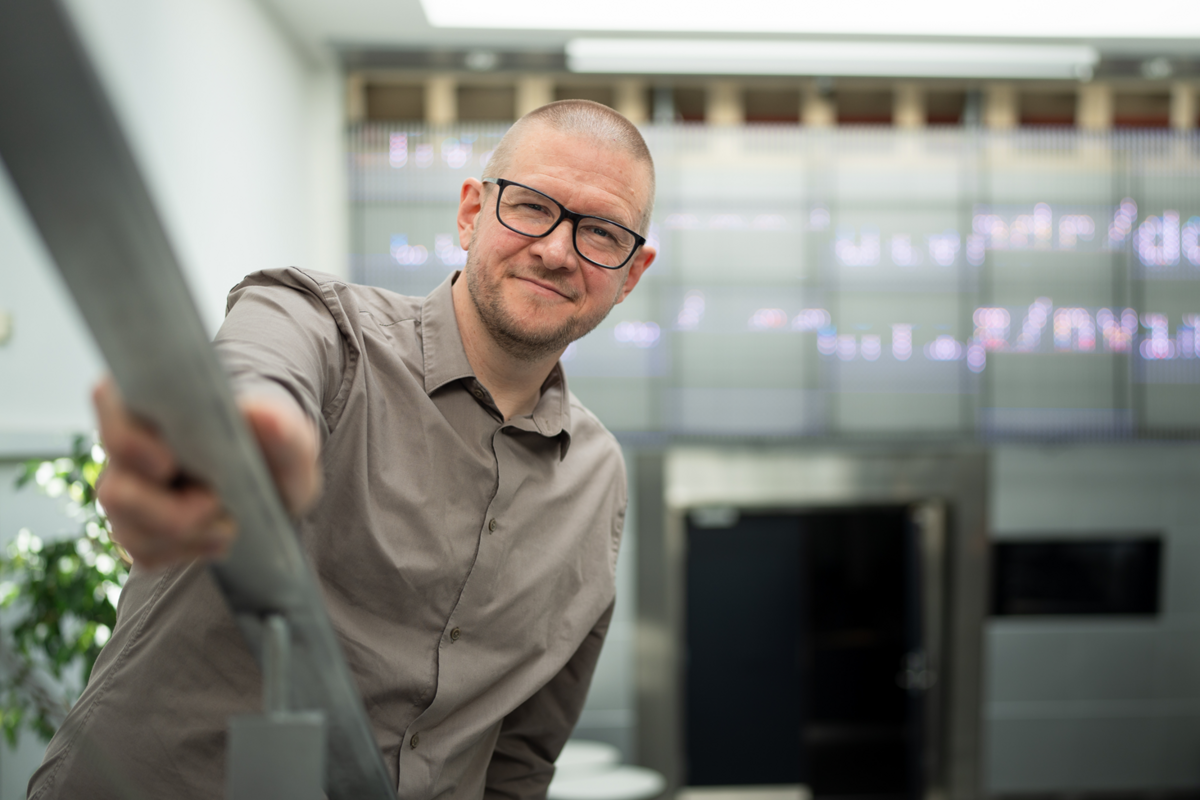
Written by Sofia Hedegaard Rasmussen
For 20 years, Clemens Nylandsted Klokmose has worked on the same fundamental question: How can software be adapted to the people who use it, rather than people having to adapt to the software they use? In recent years, the question has gained an additional dimension: how can this be done in ways that simultaneously reduce our structural dependence on platforms provided by big tech?
Technology has changed dramatically over the past two decades. We have gone from traditional software applications running on personal computers, to cloud-based software that can be used across devices and in collaboration with others, and now to software powered by artificial intelligence that can increasingly help create and adapt digital solutions. Yet the question that drives Clemens' research remains the same. As a newly appointed Professor at the Department of Computer Science, he will continue his work to give people greater influence over the digital tools they use every day.
"I'm interested in how users can help create the software they use themselves. How can people adapt software to their own needs or to the needs of a community? That's really the core idea I've been working on for almost twenty years."
Clemens' academic career began at Aarhus University. While he was still a student, Professor Susanne Bødker recognised his potential and encouraged him to become a teaching assistant. Later, she encouraged him to pursue a PhD. A decision that would shape the rest of his career.
One of the defining moments came during his PhD. After Susanne asked him to read a paper by the French Human-Computer Interaction (HCI) researcher Michel Beaudouin-Lafon, Clemens travelled to Paris to present an idea to Michel. That meeting developed into a research collaboration that has now lasted for twenty years.
Looking back, he describes his career as the result of curiosity, good mentors, and a willingness to seize opportunities when they arose.
"Many of the things that brought me to where I am today came from grabbing the opportunities that were there."
Although his research has evolved over the years, the fundamental idea remains the same. One thing that has changed is that artificial intelligence has made some of his early visions far more realistic.
Software that can be changed where it is used and while it is being used is known as malleable software. In 2015, Clemens demonstrated through Webstrates (https://webstrates.net) how this can be elegantly enabled through a small change to the rules of web technology.
However, making software malleable from a technical perspective is one thing. Making it accessible and useful for people without a background in computer science is another. Today, AI is bringing the vision of malleable software closer to reality.
"One of the gifts of AI is that ideas I've worked on for many years suddenly seem much more plausible. People can now imagine a world where users actually shape their own software."
His research explores what happens when people can create, adapt, and extend digital tools themselves, and how those tools can be made reliable enough for us to trust them.
Healthcare could be a good example. Instead of every doctor working with the same fixed user interface, Clemens envisions AI and malleable software helping to create an overview tailored to each individual patient. The system could highlight the most relevant information in a given situation, identify patterns across previous patients, or answer questions about earlier consultations. At the same time, the solution must be reliable enough for doctors to trust it when making important decisions.
"It's not enough that AI can build something. It also has to build the right thing."
For Clemens, this is where the real challenge lies. AI should help people perform their core work better, not be used to make them redundant.
"We need to help ensure that it is used in a good way."
Clemens also points out that software that is not malleable prevents ordinary people from developing strong digital skills and discourages the curiosity needed to acquire them.
"Promoting computational thinking is all well and good, but if it cannot be applied in our everyday computer use, it remains only thinking."
His interest in HCI stems from a fascination with both technology and people. With a father who was a professor of physics and a mother who taught German and philosophy, he grew up surrounded by both science and the humanities. Before choosing computer science, he even considered studying musicology or Nordic studies.
"I've always been interested in both the technical and the human side. HCI gave me a place where I could work with both."
This interdisciplinary perspective was strengthened during five years as Associate Professor at the Department of Digital Design and Information Studies at the Faculty of Arts before returning to the Department of Computer Science. Today, he builds bridges between research communities and helps researchers from different academic backgrounds work together on shared challenges. Among other things, he does so through his role as co-director of CAVI together with Professor Kim Halskov from Digital Design and Information Studies.
Teaching has always been just as important as research. Whether introducing students to HCI or supervising projects, he is motivated by helping students see problems from new perspectives and step outside their comfort zones. As Professor, he hopes to spend even more time supporting the next generation of researchers.
"If you see a spark, whether in a bachelor's student, a PhD student or a postdoc, you should make sure to nurture it. That's more important than pursuing your own research ideas."
Several of the researchers he has supervised have since continued in academic careers. Seeing others develop as researchers is one of the most rewarding aspects of his work. For Clemens, becoming Professor feels like a natural next step. Alongside his own research, he hopes to contribute even more to the department and to the people who are part of it.
"It feels like a natural movement from focusing a lot on my own work to looking a bit more towards the department and the university and engaging more with the bigger picture."
When the working day is over, family and music take centre stage. Together with his wife and their two children, he enjoys playing music whenever time allows, while his passion for vinyl records and classic computer games remains a constant part of his spare time.
The question that first inspired his research almost 20 years ago continues to drive him today. Technology has changed, but his ambition remains the same: to give people greater influence over the technology they use every day.
Stund: Activity-Enriched Collaborative Workspaces Mediated by Artificial Intelligence
Borowski, M., Kristensen, J. B., Panda, P., Rintel, S., Elmqvist, N., Grønbæk, J. E., & Klokmose, C. N.
In proceedings of the 39th Annual ACM Symposium on User Interface Software and Technology Association for Computing Machinery (UIST '26).
Webstrates: Shareable Dynamic Media. In Proceedings of the 28th Annual ACM Symposium on User Interface Software & Technology
Klokmose, C. N, Eagan, j. R., Baader, S., Mackay, W., and Beaudouin-Lafon, M. 2015.
In proceedings of the 28th Annual ACM Symposium on User Interface Software & Technology, p. 280-290 (UIST '15)
https://doi.org/10.1145/2807442.2807446
The human–artifact model: An activity theoretical approach to artifact ecologies
Bødker, S., & Klokmose, C. N.
Human–Computer Interaction, 26(4), 315-371.
