Written by Michaela Stigaard Thulesen, Faculty of Natural Sciences
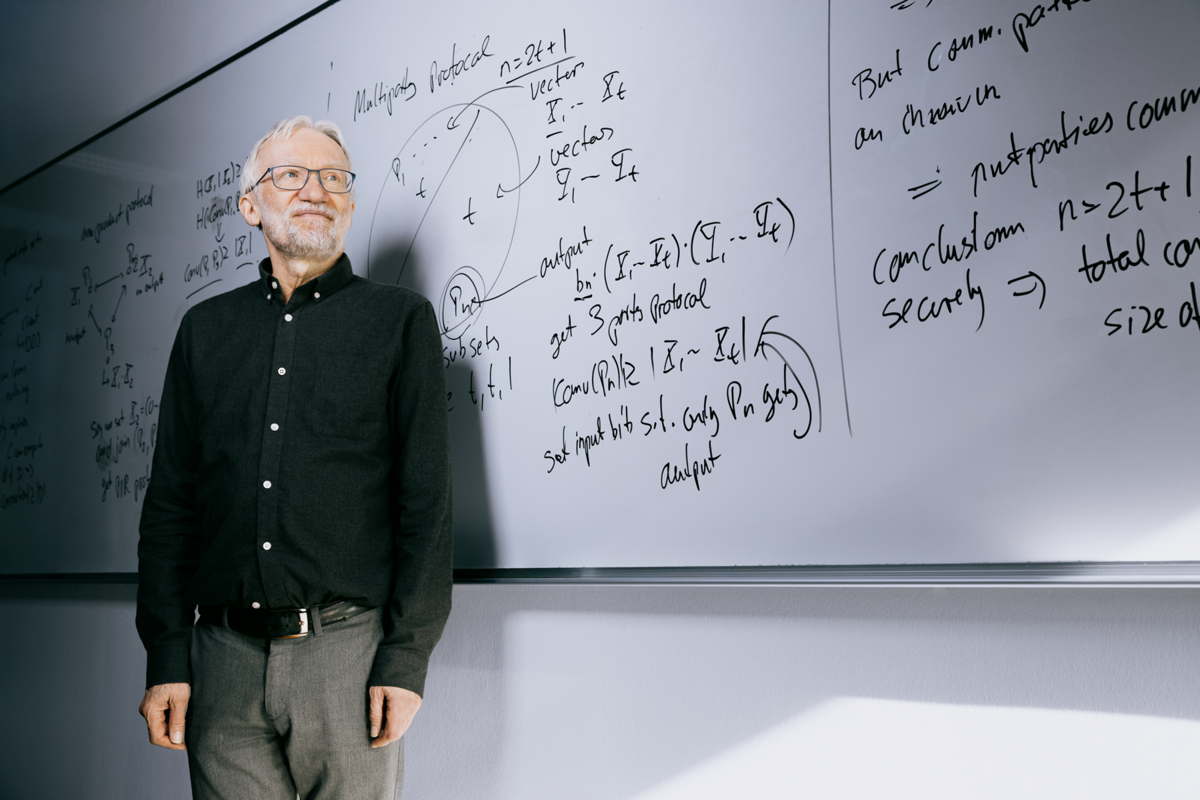
For forty years, Ivan Bjerre Damgård has been keeping our personal information safe. He’s a cryptologist who’s responsible for foundational breakthroughs in the art and science of using code to keep data out of the wrong hands. In recognition of his achievements, Damgård will receive this year’s Rigmor and Carl Holst-Knudsen Award for Scientific Research.
Everyone who knew anything about cryptology was there. Leading researchers in the field – David Chaum, Shafi Goldwasser, Silvio Micali, Gilles Brassard and many others – were gathered in the same room in Amsterdam back in 1986 to pick each other’s brains about the emerging field of cryptology. They were the pioneers in a field that was barely a decade old at the time.
Among them sat a young man none of them had ever heard of – and who’d never heard of them either: a PhD student from Aarhus University who had joined them that day in Holland as part of his studies in coding theory and cryptography. But over the decades that followed, this unknown young man would go on to become one of the world’s most prominent and prolific cryptographers: Ivan Bjerre Damgård.
“This wasn’t my own career plan, the field was relatively new, but my PhD supervisor sent me to Holland to sit in on some talks and classes about cryptography, and I was sold. I was in the right place at the right time, and I seized the opportunity that presented itself to learn more about a new world,” Damgård says.
I spoke to Damgård on a video call during the summer holiday. He was sitting on a sofa, wearing a cheerful pink and green floral print shirt, relaxed and smiling as he waited for my questions. But he’s not one to go on and on about his own achievements. Quite the opposite - his answers were measured and understated. It was as he was waiting for me to figure out just the right combination of words to unlock his thoughts. And then he says:
“Well, it’s not as if I feel a strong need to boost my ego as such – but of course, it’s really nice to receive recognition from your place of work. I suppose it means I must have done something right.”
Damgård is a cryptologist and a professor at the Department of Computer Science. He’s internationally recognised for his research and has over 180 peer-reviewed publications and 33,000 citations to his name. But his success is not the result of a solo effort, he stressed:
“No, I believe that when something new and exciting happens in science, as a rule it’s because some people somewhere are talking to each other about something. It’s a collective effort. I may have published a handful of articles as sole author, but all of the others were written in collaboration with lots of colleagues, students, etcetera. If it weren’t for them, there just wouldn’t have been nearly as many achievements,” he said.
Back in 1988, when he was still a PhD student, Damgård – together with David Chaum and Claude Crépeau – wrote an article about a revolutionary data security solution, multiparty computation (MPC). Twenty years later, in 2008, MPC would be used by AU and UCPH to develop a digital auction house for Danish farmers. Thanks to MPC, farmers could do business with each other in a secure system where individuals could submit bids without revealing them to one another.
“That’s really where I think we made history in a different and bigger way than by publishing an article,” Damgård said.
Today, MPC is widespread in a variety of sectors where there’s a need to regulate access to private information within a system, for example in healthcare and transportation: your personal information can be shared, but only with the right recipients. The approach is so widespread now that it’s easy to overlook that translating the idea of MPC into practice took two decades.
“It was almost too futuristic when we invented the method back in the 80s. Sometimes when you have something that’s ahead of its time in some way, people don’t always get what you’re actually talking about. Even we sometimes thought ‘That just can’t be done’ along the way, but we kept at it and were stubborn about it, and so it worked. I think that’s both fascinating and inspiring,” Damgård said.
Sometimes Damgård shuts the door on his research to devote himself to another passion: music.
“That’s my other life. Music is what I turn to when I’m not doing research,” the professor explained.
Music came into Damgård’s life when he was an eight-year-old kid in western Jutland; his mother gave him a choice between the piano and the violin, and he chose the latter. Since then, music has been the cryptologist’s faithful companion. Damgård now plays the guitar and mandolin as well, and he performs and records folk music with his band and his wife.
“Music is something I’ve needed to turn to in my life. If I get stuck on something in my research, I can play music. It recharges me. Just like research can give me energy when I get stuck with my music. For me it’s a necessity.”
Not only is Damgård just as passionate about music as he is about cryptology; his musical accomplishments have earned him recognition as well. In 2007, he received a Danish Music Award Folk (Danish composer of the year) and in 2014, he was named ‘rigsspillemand’ (an honour recognising excellence in Danish folk music).
Ivan does not reveal much emotion during the conversation about his career, but when he hears why the dean has nominated him for the award, a smile begins to form. As if he is trying to maintain his composure, even though the words – both new to him and highly flattering – would be enough to make anyone burst with pride.
“It’s certainly nice to hear. And it’s also quite fun to hear about everything that has happened over the 40 years I’ve been at AU,” he says with a slight smile.
In addition to Multiparty Computation, Ivan Bjerre Damgård has developed new methods for public-key encryption, hash functions and Oblivious RAM. According to the nomination for the Rigmor and Carl Holst-Knudsen Award for Scientific Research, he has published more than 180 peer-reviewed articles in international journals and conference proceedings and ranks second on the International Association for Cryptologic Research’s (IACR) list of “Most Prolific Authors in Cryptography”, with 144 articles published under the auspices of the IACR. His H-index was 82 in February 2025. The nomination also notes that he has co-founded the companies Cryptomathic, Partisia and Sepior.
He also founded the Section on Cryptography and Cyber Security, a research group with around 27 staff members. According to csrankings.org, the group is among the world’s leading research groups based on contributions to research publications in the field’s most prestigious international publication venues over the past 30 years. Ivan Bjerre Damgård has no doubt: the group is by far his greatest achievement.
“It’s very special – everyone in the field will tell you that. We have a collaborative culture that is quite unique. People aren’t competitors; instead, they collaborate across the group in all sorts of ways, and that boosts productivity. We have outstanding people in the group, and we have them because we’ve succeeded in creating the right culture. It’s a great group that people from all over the world want to be part of. And I’m damn proud of that.”
The Rigmor and Carl Holst-Knudsen Award for Scientific Research will be conferred on Ivan Bjerre Damgård at the annual celebration at Aarhus University on 11 September 2026.
Read more about the Rigmor and Carl Holst-Knudsen Award for Scientific Research [In Danish].
