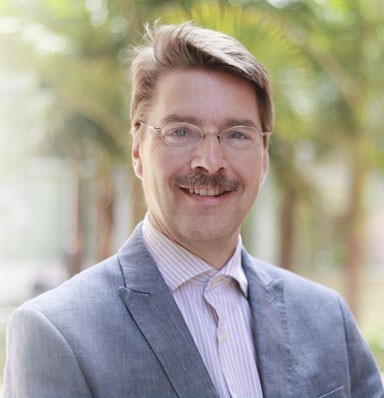
More than three decades after graduating from Aarhus University, Professor Jens Palsberg is back for a six-month sabbatical. Now a leading researcher at UCLA, he is fascinated by a scientific challenge that may take decades to fully unfold - quantum computing.
When Jens Palsberg began studying computer science at Aarhus University in 1983, the research environment was considerably smaller than today. Now, he has returned to Aarhus for a six-month sabbatical from the University of California, Los Angeles (UCLA), where he is a professor of computer science. Some of the professors who once taught him are still around, but a new generation of researchers and students has transformed the department.
Palsberg graduated from Aarhus University in 1992 and subsequently built an international research career in programming languages and software engineering. Today, much of his attention is focused on a field that was barely imaginable when he began his studies: quantum computing.
Jens Palsberg's journey into quantum computing began almost by coincidence. In November 2018, he organised a session on the future of computing at a UCLA faculty retreat. He invited two speakers to discuss quantum computing, one from Google and another from UCLA's physics department.
"I was one of those who got interested and started to read up on it very soon after. And eventually just moved my research into that area," he recalls.
For a researcher who had spent decades working on programming languages and software engineering, quantum computing offered an opportunity to apply his expertise to an entirely new set of challenges. And according to Palsberg, the field is still in its infancy.
"I think a reasonable comparison is to say that quantum computing today is like computer science was in 1960," he explains.
Just as computers have developed enormously since the 1960s, he expects quantum computers to become significantly more powerful and useful in decades ahead.
Quantum computers operate according to fundamentally different principles than conventional computers. While they are unlikely to replace our laptops, they could become powerful tools for solving specific types of problems.
Palsberg compares their potential role to that of graphics processing units (GPUs), which are already widely used in data centres. One promising application is the development of new medicines, where quantum computers could help researchers model molecules and evaluate potential drug candidates more efficiently.
But significant challenges remain. One of the biggest is reliability. Unlike conventional computers, today's quantum computers are highly susceptible to errors. Developing methods to detect and correct these errors is therefore essential.
"A major challenge is that we need the software that we run on quantum computers to be fault tolerant because the quantum computers as we know them are not as reliable as your laptop," Palsberg explains.
For years, much of the progress in quantum computing depended on advances in physics and the development of more reliable qubits, the fundamental units of quantum information. But as the technology develops, computer science is becoming increasingly important.
"Now some of the challenges in the field are moving to be computer science challenges. That's the exciting part of being a computer science person in quantum computing this decade."
Palsberg's research focuses on making quantum programs easier to develop, more efficient and more reliable. He is also exploring how artificial intelligence can help researchers develop and verify quantum algorithms, including generating mathematical proofs that can be checked automatically.
Throughout his career, Jens Palsberg has been motivated by discovering connections between research areas that may initially appear unrelated. Earlier in his career, he helped establish important connections between type systems and static analysis. Today, he applies the same approach to quantum computing, bringing together ideas from computer science, physics and other scientific disciplines.
"What I really like is building connections between sub-areas people didn't think were that connected," he explains.
For him, the most rewarding research problems are not necessarily those that require the most resources, but those that demand a genuinely new idea.
"I like to work on problems where one really needs a new idea, not just more work."
Quantum computing has introduced him to researchers from physics, chemistry, electrical engineering and materials science, opening opportunities for collaboration that would not otherwise have existed.
Despite his many years in academia, Jens Palsberg shows no signs of losing his enthusiasm for research. When asked what he is most proud of, he first mentions his former PhD students, many of whom have gone on to successful research careers of their own. For Palsberg, seeing his students succeed is one of the most rewarding aspects of his career.
But he is equally enthusiastic about the scientific challenges ahead. Quantum computing, he believes, is a field with a long future, and that is precisely what makes it attractive.
"I'm very motivated by a field that's early. I like long horizons. I have no problem with working on things that will be relevant and applicable more than a decade down the road."
He describes quantum computing as potentially his last major research endeavour. And while nobody knows exactly when quantum computers will reach their full potential, Palsberg is in no hurry. For a researcher who has spent his career connecting ideas and exploring new possibilities, the opportunity to help shape an emerging field is motivation enough.
Since 1 July 2026, Jens Palsberg has been spending his sabbatical at the Department of Computer Science at Aarhus University. His decision to return was motivated partly by personal reasons, but Aarhus also offered an opportunity to reconnect with researchers working in areas closely related to his own.
During his stay, he has been exchanging ideas with researchers including Jaco van de Pol, Bas Spitters and Anders Møller, exploring possible connections between their different research interests. He also hopes his visit can contribute to stronger research ties between Denmark and the United States, particularly within quantum computing.
"I hope that some new collaborations can come up that actually can endure, not just when we are visiting each other, but can continue after we all go home," Jens concludes.
