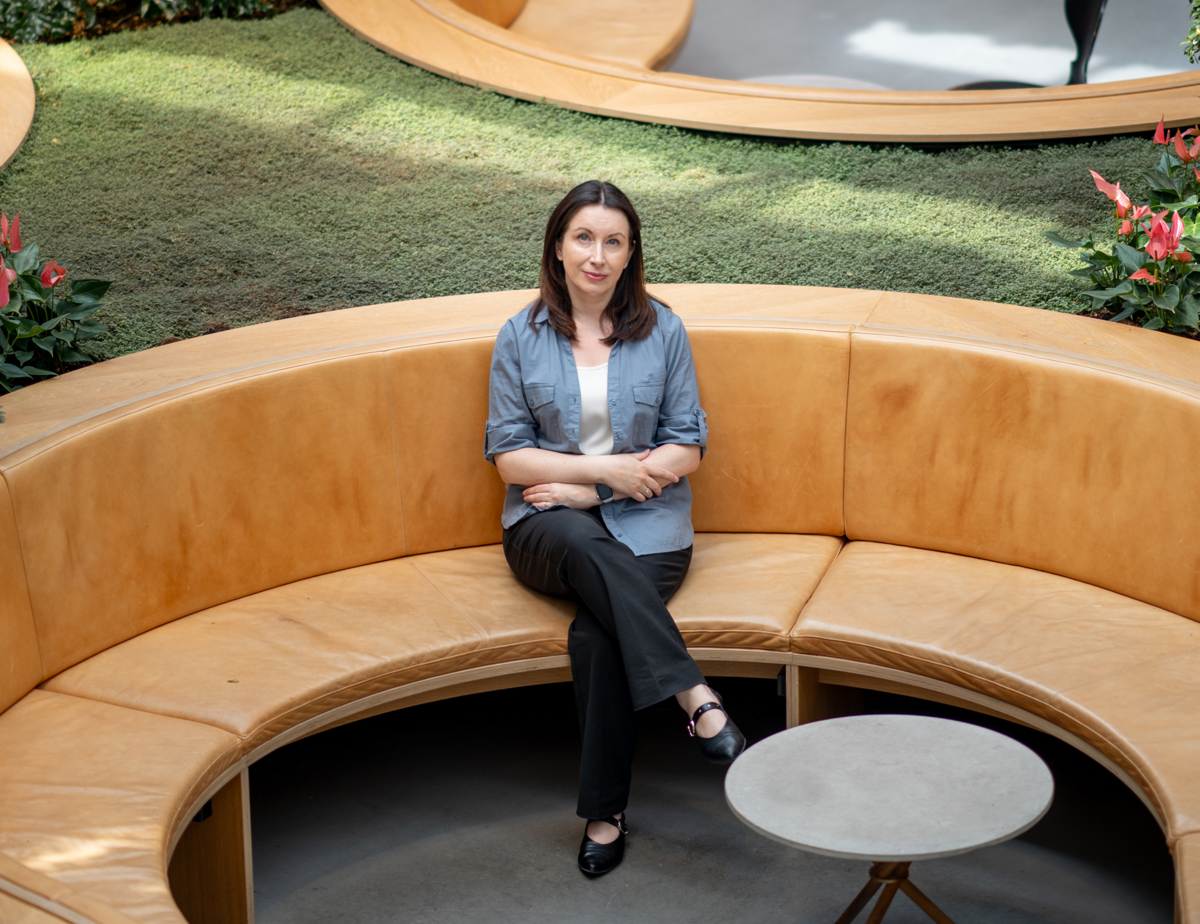
Written by Sofia Hedegaard Rasmussen
When Eve Hoggan joined the department in 2016, she planned to continue her research on multimodal interaction. She wanted to understand how people experience technology through touch, sound and movement. Ten years later, that work has grown into new research directions, an ERC Consolidator Grant in 2025 and now a promotion to professor.
At Aarhus University she found one of Europe's strongest research environments in human-computer interaction. Working alongside colleagues in participatory design and computer-supported cooperative work (CSCW) broadened her perspective and inspired her to combine her expertise in multimodal interaction with new questions about collaboration.
"I learned so much from the people here," Eve says. “The things I'd worked on before suddenly made sense in a completely new context. I've not really changed direction, I've expanded!”
Today, much of Eve's research focuses on one of the defining challenges of modern working life: how people can collaborate around physical objects when they are not in the same room.
Video meetings let us see and hear one another. But as soon as people need to sketch on a prototype, inspect a physical model or handle an object together, the experience changes completely.
"As soon as physical objects become part of the collaboration, everything breaks down," she explains. “How can we make it possible for people to interact with those objects even when they're not actually there?”
That question sits at the centre of her ERC-funded project MIRA: Multimodal Interaction for Remote Physical Artefacts. The project explores new technologies that allow people to see, manipulate and experience physical objects across distance using multiple senses. The goal is not simply to recreate an in-person meeting.
"Technology doesn't just have to imitate being together," Eve says. “It can also create completely new ways of collaborating.”
Research and teaching go hand in hand for Eve. She wants students to leave her courses with practical skills they continue using throughout their studies. She teaches both the bachelor's course Physical Computing and the master's course Multimodal Interaction.
In Physical Computing, students move beyond writing software and learn to build interactive technologies using electronics, sensors, actuators and 3D printing. By the end of the semester, they have designed and built their own working prototypes. The master's course explores how people interact with technology through multiple senses. Students combine theory with practical design challenges and, in recent years, have worked with industrial collaborators in Denmark on problems related to remote collaboration.
Eve is also Programme Manager for IT Product Development. Since taking on the role, she has helped lead a major redesign of the bachelor's programme. Looking ahead, she wants to continue developing the programme while preserving what makes it distinctive.
"IT Product Development is actually quite a rare programme," she says. “There are only a few similar programmes around the world. Our graduates have strong computer science skills, but they also understand design. That's a special combination.”
Looking back, Eve describes her career as a series of opportunities rather than a carefully planned path.
She originally studied both music and computer science at the University of Glasgow. At first, she imagined becoming a professional musician. Then she discovered human-computer interaction and found a field that combined creativity, technology and working with people. Research positions in Finland followed. Conversations at conferences led to new collaborations. One of those collaborations eventually led to Aarhus University. She describes the department as a place where researchers share ideas freely across groups and disciplines.
“Some of our best projects started because we bumped into each other in the corridor and began talking.”
As professor, she wants to help preserve that culture. She credits much of her own development to mentors and generous colleagues. Now she wants to offer the same support to early-career researchers and help maintain the collaborative environment that first attracted her to Aarhus.
“I want to help keep the spirit we have here. That's what makes this place special.”
Outside the university, Eve enjoys spending time with her husband and two children. When she has the chance, she takes her gravel bike into the forests around Aarhus or to the beach for a swim. Music is still part of her life too, as she plays in the Aarhus Amateur Symphony Orchestra.
The path from Glasgow to Aarhus was never part of the plan. Sixteen years after leaving Scotland for what was meant to be a three month stay in Finland, she is still following the opportunities that come her way.
Co-Designing Multimodal Tools for Radically Mobile Hybrid Meetings.
Kleinau, J., Grønbæk, J. E. S., & Hoggan, E.
In Proceedings of the 2025 CHI Conference on Human Factors in Computing Systems (pp. 1-17).
This paper was published in the most prominent venue for HCI publications, ACM CHI, and received an Honorable Mention Award. The research reported in the paper explores the concept of radically mobile hybrid meetings. Our work investigates the design space of multimodal devices as mobile alternatives to traditional videoconferencing for spontaneous, effective, and inclusive collaboration.
https://dl.acm.org/doi/full/10.1145/3706598.3713993
Whispering through walls: towards inclusive backchannel communication in hybrid meetings.
Mu, Q., Borowski, M., Grønbæk, J. E. S., Bødker, S., & Hoggan, E. (2024, May).
In Proceedings of the CHI Conference on Human Factors in Computing Systems (pp. 1-16).
This paper was published in the most prominent venue for HCI publications, ACM CHI. The work focuses on the development of the first ever system for voice-based backchannel communication in hybrid meetings.
https://dl.acm.org/doi/full/10.1145/3613904.3642419
Achieving symmetry in synchronous interaction in hybrid work is impossible.
Bjørn, P., Busboom, J., Duckert, M., Bødker, S., Shklovski, I., Hoggan, E., ... & Boulus-Rødje, N. (2024).
ACM Transactions on Computer-Human Interaction.
This article summarises many of the results from the DIREC ReWork project on the future of hybrid work. Through observational studies and interviews, we found that incongruences in technological frames create significant gaps in collaboration, making asymmetry a fundamental characteristic of all hybrid work situations.
