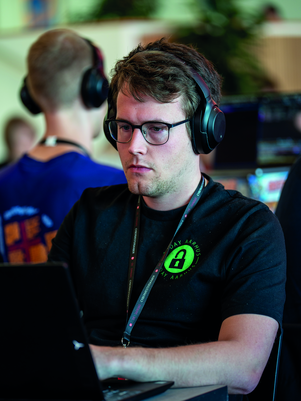
He has tried it before. Bootcamps, competitions, and long tasks where the solution is hidden behind several layers of code and logic. The goal is clear: a spot on the national cyber team. We spoke with Luccas Constantin-Sukul, a master’s student in computer science at Aarhus University, about the path into cybersecurity, the fascination with hacking, and why it feels a bit like being a spy.
How do you actually become part of the national cyber team?
“There are first the national championships, which take place at the beginning of May, where there are 110 participants. After that, the coaches select 20–30 people for a bootcamp, and in the end 10 are chosen for the national team,” he says.
In other words, the path is long and the competition is tough. Luccas himself has participated for several years in the national championships and bootcamp and has been very close before.
“Last year I was actually offered a place on the national team, but I was on exchange in Australia as part of my studies, so I couldn’t accept it.”
How long have you been working with cybersecurity?
“I’ve been participating in the championships since 2019, when I attended the bootcamp for the first time. But the interest started much earlier.” He rewinds all the way back to primary school.“I was in the 9th grade when a friend’s father found a competition from the Danish Defence Intelligence Service in a newspaper. It was a kind of puzzle you had to solve. My friend and I tried, and we solved it.”
It became the beginning of something bigger. “Then you had to go to the university and work further on the task. It was exciting. It felt a bit like we were spies. My friend was much better than me, and it ended with him making it onto the national cyber team that year.”
What makes cybersecurity exciting?
“That’s a good question,” he says, thinking for a moment. For Luccas, it’s not just the technical aspect that draws him in.
“I’ve been very inspired by the environment. I’ve also helped start an association at Aarhus University called 0-Day Aarhus, where we take part in competitions and give talks on cybersecurity and things like that.”
At the same time, the understanding of how important cybersecurity is has grown over time.
Luccas is a master’s student in computer science at Aarhus University and will graduate this summer. He grew up in Risskov near Aarhus and attended primary school at Risskov Skole and later Skæring Skole. He completed his upper secondary education at Aarhus Gymnasium (HTX), focusing on mathematics and programming.
His interest in cybersecurity began already in primary school and was later strengthened through participation in competitions and communities such as the cybersecurity association 0-Day Aarhus, which he himself helped establish. Today, he is working purposefully toward securing a place on the Danish national cyber team.
“The more you know about it, the more you realize how important it is, and how many companies actually have quite big problems.”
He compares it to insurance.
“You get cybersecurity to prevent something bad from happening. But there’s also a big value in cybersecurity today. Many people won’t buy software if the companies behind it don’t have security under control.”
What do the tasks involve?
“It’s a bit like what you do in real life, but there’s an important difference: in the tasks, you know there is always a vulnerability. In real life, that’s not certain, and the systems are often much bigger and more complex.” A typical task might be to find a way into a system.
“I remember one task where you had to find a login on a website and crack a password. It took a long time, but in the end, it worked, and I found what I was looking for.” It’s exactly that feeling that drives him.
“It’s very puzzle-like. You often have to learn something new to solve the task and find small clues along the way. It’s really cool!”
What do you want to get out of making the national team?
“I’ve been at it for so long, so it would just be really cool to make it,” he says. But it’s not only about being selected.
“I want to improve and work together with some of the most skilled people. And it would also be great to take part in the European competition.” Collaboration plays a big role.
“I really like solving tasks together with others. That’s what we do in the association as well.”
What do you want to work with after your studies?
Luccas will graduate with a Master of Science in computer science this summer and has already secured a job in an IT security company.
“I’m not entirely sure what I’ll be working on yet. I think that’s something I’ll figure out when I start.”
But some things are more fun than others, he explains: “I think it’s fun to work with penetration testing, where you deliberately try to hack companies to find their vulnerabilities.”
Why do we need more people like you?
According to Luccas, there are still many people who don’t think enough about cybersecurity.
“It’s not something everyone thinks about in their everyday life, but maybe they should,” he says. At the same time, threats are becoming more complex and require more skills.
“I think many people have an idea that hackers are individuals sitting alone in a basement tinkering. That’s not how it is in reality. It’s quite organized, and there are many people working together. Those who carry out serious attacks are often large organizations or services in hostile nations, so there are significant forces behind it.”
This makes the need for skilled specialists even greater.
What is the next step?
The national championships are now completed, so the next step is the bootcamp and then possibly a place on the national team. And the motivation is unmistakable.
“I really want to be on the national team, and this year I finally have the time to do it—so now it has to happen!"
___________________________________________________________________________________
This article was originally written by Jesper Bruun · journalist, AU Engineering, Aarhus Universitet and published in Aktuel Naturvidenskab, issue no. 3-2026.
